
To record ad-libs, finish your lead and backing vocals first, then record ad-libs on their own track (or tracks) with a looser, freer delivery, aiming for short phrases that fill gaps around the lead rather than competing with it. Record several passes, keep only the best moments, and place them lower in level and to the sides of the mix so the lead stays clear.
Ad-libs are the extra vocal moments — shouts, runs, echoes, little spoken bits — that make a vocal performance feel alive. They’re easy to overdo and surprisingly easy to underdo. Here’s how to plan, perform and place them.
What ad-libs are
An ad-lib is an improvised or semi-improvised vocal part that sits around the main vocal. Common types:
- Echoes: repeating a word or phrase from the lead (“tonight… tonight”).
- Responses: short replies to the lead line, like call-and-response.
- Runs and riffs: melodic flourishes, often in a chorus or outro.
- Hype and exclamations: “yeah,” “come on,” shouts that add energy.
- Spoken lines: short talking bits between phrases.
Ad-libs are different from harmonies, which are planned notes sung with the melody, and from doubles, which repeat the melody exactly.
Plan where ad-libs go
Ad-libs work best in the gaps. Listen through the song with the lead vocal and mark:
- gaps at the ends of lines, where the lead breathes;
- the end of choruses, where energy can lift;
- the final chorus and outro, where ad-libs often build;
- instrumental breaks, where a vocal moment keeps interest.
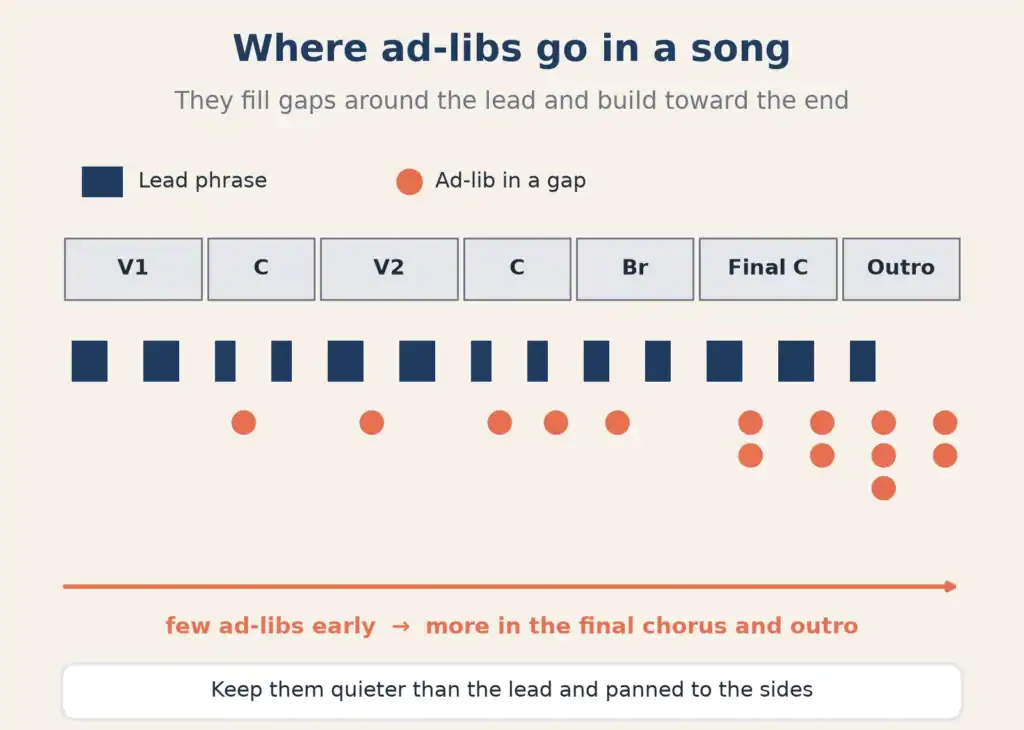
Note these spots on your lyric sheet — a simple “AL” in the margin works.
Less is usually more
A few great ad-libs in the right places have more impact than constant ones everywhere. Leave room for the song to breathe.
How to record ad-libs, step by step
1. Finish the lead vocal first
Ad-libs react to the lead, so you need the final lead in place. Recording ad-libs on top of a scratch vocal usually means re-doing them later.
2. Set up dedicated ad-lib tracks
Create one or two new tracks just for ad-libs. Some artists use separate tracks for different types — one for echoes, one for runs — which makes it easier to place them later.
3. Loosen up your delivery
Ad-libs sound best when they’re relaxed. Some ways to get there:
- move around a little and change your energy;
- record with the lights low or the room set up differently;
- try a different mic distance for a different feel.
4. Record whole-song passes
Sing along to the entire song and improvise freely. Do three or four passes. You’ll catch ideas you’d never plan.
5. Then target specific spots
After a few full passes, loop the sections you marked and record focused ad-libs there. Try different ideas in each pass.
6. Pick the best moments
Go through your passes and choose only the strongest ad-libs. Delete or mute everything else. If an ad-lib is almost right, punch in a better version rather than keeping a weak one.
Ad-lib delivery tips
- Stay in key. Even improvised runs need to fit the chords.
- Don’t step on the lead. If an ad-lib covers an important word, move it or cut it.
- Vary the energy. Some soft, some intense — matching where the song is.
- Be yourself. Ad-libs are where your personality comes through.
- Watch the language. If you plan a radio edit or clean version, check your ad-libs too.
Placing ad-libs in the mix
When you balance the song, ad-libs need to sit behind the lead:
- Level: usually quieter than the lead vocal.
- Panning: often to the sides, leaving the center to the lead.
- Space: a little more reverb or delay than the lead can push them back.
- Timing: tidy starts and ends so they don’t clash with lead phrases.
Listen in a rough mix to check that they add energy without getting in the way.
Common ad-lib mistakes
| Mistake | Fix |
|---|---|
| Too many ad-libs everywhere | Keep only the best; leave gaps empty |
| Ad-libs covering the lead | Move them into gaps, or lower them |
| Ad-libs out of key | Re-record using notes from the chords |
| Ad-libs sounding stiff | Loosen up and do more free passes |
| Ad-libs too loud | Lower them and pan them to the side |
For getting the core lead vocal right before you add ad-libs, Songsmith’s 13 tips for recording better vocals at home is a good starting point, and how vocal doubling enhances recordings explains the difference between doubling and these extra parts.
FAQ
How do you record ad-libs?
Record your final lead first, then sing several free passes on separate tracks, focusing on gaps and high-energy moments. Keep the best moments and mix them lower than the lead.
When should ad-libs be recorded?
After the lead vocal and backing vocals are done, so the ad-libs respond to the final performance.
How loud should ad-libs be?
Usually quieter than the lead vocal. They should add energy without pulling attention from the main line.
Where do ad-libs go in a song?
Most often in gaps at the ends of lines, at the end of choruses, in the final chorus and in the outro.
Should ad-libs be panned?
Often, yes. Panning them to the sides keeps the center clear for the lead vocal.