
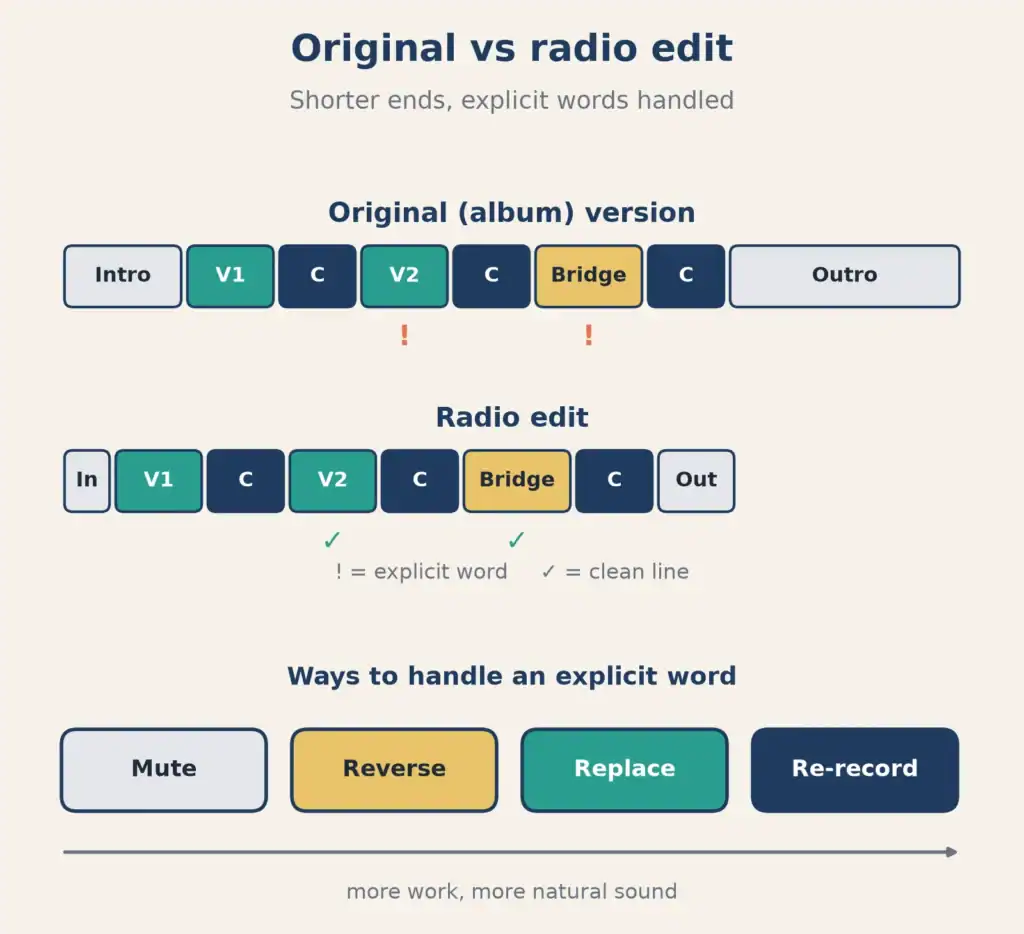
A radio edit is a version of a song that’s been changed to suit radio play — usually made shorter, with a quicker intro or outro, and with explicit words removed or replaced. A clean version is the closely related edit in which strong language or explicit content is muted, swapped or re-recorded so the song can be played in more places. Many songs have both an original (or “album”) version and a radio edit.
If you’re an independent songwriter thinking about radio, playlists, or simply offering a family-friendly version, knowing how these edits work helps you plan before you record.
Radio edit vs clean version vs original
| Original / album version | Radio edit | Clean version | |
|---|---|---|---|
| Length | As written | Often shorter | Usually the same as the original |
| Language | Unchanged | Explicit content removed or replaced | Explicit content removed or replaced |
| Structure | Full intro, solos, outro | Intro, solos or outro may be trimmed | Unchanged |
| Where it’s used | Albums, streaming | Radio, some playlists | Anywhere a non-explicit version is preferred |
In everyday use, people often say “radio edit” and “clean version” interchangeably. Strictly, a radio edit is about fitting radio — which can mean length and structure as well as language — while a clean version is about content.
Why songs get radio edits
- Length. Radio and some playlists favor shorter songs, so a long intro or extended ending may be trimmed.
- Getting to the song faster. Shortening the intro gets the vocal in sooner.
- Content. Stations and other outlets often have their own standards about language, so a version without explicit words is more widely playable.
- Choice. Some listeners simply want a clean version.
Each outlet sets its own expectations, so if you’re submitting to a particular station or playlist, check what they ask for. For the submission side of radio — approaching stations and getting airplay — see Songsmith’s guide on why independent artists should get radio play. This page is about making the edit itself.
How to make a radio edit of your song
1. Decide what the edit needs to change
Listen to the original and ask:
- Is the intro long before the vocal starts?
- Are there instrumental sections that could be shortened?
- Is the outro extended or does it fade for a long time?
- Are there any explicit words or lines?
Write down timestamps for each change. A rough mix or the final mix is fine for this listening pass.
2. Plan the shortened structure
Common moves:
- Shorten the intro to a few bars, or start on the first verse.
- Trim a repeated section, like a second pre-chorus or an extended bridge.
- Shorten the outro with a cleaner ending or an earlier fade.
Keep the song’s shape. The chorus and hook should still land where listeners expect them.
3. Make the edits on bar lines
Cut on downbeats and at the start of bars, so the edit stays in time. Use short crossfades at each edit to avoid clicks. If you recorded to a click, this is much easier.
4. Handle explicit content
There are a few common approaches, from least to most work:
- Mute the word.
- Reverse the word, so the sound is there but unintelligible.
- Replace it with a sound effect or instrumental hit.
- Re-record the line with different words.
Re-recording usually sounds the most natural. If you write it in from the start, you can record the alternate line while your voice and setup are the same, using punch-in recording so it matches the original take.
5. Check the transitions
Listen to the whole edit from top to bottom, several times. Every cut should feel natural, as if the song was always that way.
6. Name and label the files clearly
Label each version so it can never be confused: Song Title (Radio Edit), Song Title (Clean), Song Title (Original). Keep a note of the length of each.
Planning clean lines while you write and record
The easiest radio edit is the one you plan for:
- Write an alternate line for anything explicit while you’re still writing.
- Record the alternate in the same session as the original vocal.
- Note it on your lyric sheet so the two versions are documented.
Any ad-libs need checking too — explicit content often slips into ad-libs and gets missed.
Releasing more than one version
If you plan to release a clean or edited version alongside the original, most distribution services ask you to mark whether each track contains explicit content. Check your distributor’s own guidelines for how to label versions. Before releasing anything, it’s worth going through Songsmith’s checklist of things to do before posting your music.
FAQ
What is a radio edit?
A radio edit is a version of a song adapted for radio, usually shorter and with any explicit language removed or replaced.
What is a clean version of a song?
A clean version is a version where explicit words or content have been muted, replaced or re-recorded.
What does radio edit mean on streaming services?
It usually means the edited version that was made for radio — shorter, cleaner, or both — rather than the original album version.
What’s the difference between a radio edit and the original?
The original is the full version as written and released on the album. A radio edit is shorter and/or has explicit content removed.
Do independent artists need a radio edit?
Not always. It’s worth making one if you plan to approach radio, if outlets you’re targeting prefer clean versions, or if the song is long.