
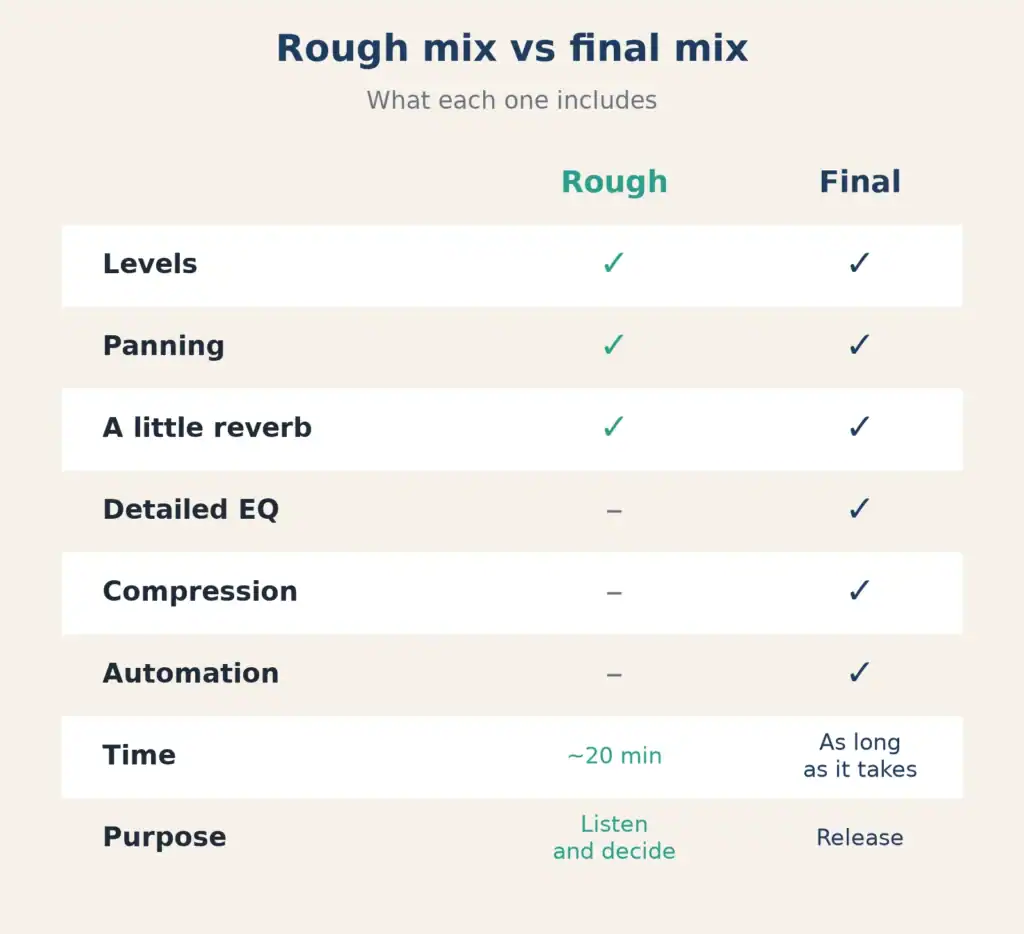
A rough mix is a quick, working balance of a song’s tracks — levels, panning and maybe a little effect — made during or right after recording so you can hear where the song stands. It isn’t the final mix. It’s a listening copy: something to check performances, share with collaborators and live with for a few days before making bigger decisions.
Songwriters who record at home make rough mixes constantly, often without calling them that. Doing it deliberately makes every session more useful.
Rough mix meaning, in plain terms
In a studio, at the end of a tracking day, the engineer will often push the faders into a sensible balance and bounce a copy for the artist to take home. That’s a rough mix. It’s “rough” because it’s made quickly, with little or no detailed processing, and everyone understands it will change.
The key ideas:
- It’s fast. Minutes, not hours.
- It’s for listening, not for release.
- It’s disposable. You’ll make many of them over a project.
Rough mix vs final mix vs demo
| Rough mix | Final mix | Demo | |
|---|---|---|---|
| What it is | A quick balance of the current tracks | The finished balance and processing for release | A recording that presents a song |
| When | During and after tracking | After all recording and editing | Before committing to a full production |
| Time spent | Minutes | As long as it takes | Usually short |
| Who hears it | You, your band, your collaborators | Listeners | Collaborators, singers, producers |
A demo can be played as a rough mix — many are. But “demo” describes what the recording is for, while “rough mix” describes how far along its balance is. For more on that distinction, see demo vs master recording.
Why rough mixes matter for home recordists
When you’re the songwriter, performer and engineer at once, it’s easy to lose perspective. A rough mix gives it back.
- You hear the song, not the session. Away from your recording software, you notice the things a listener notices.
- You catch performance problems while there’s still time to re-record.
- You make arrangement decisions — whether that extra guitar is needed, whether the bridge drags.
- Collaborators hear the same version you do, so feedback is about the same thing.
- It becomes a reference. Sometimes a rough mix has a feel the final mix needs to keep.
How to make a rough mix in under 20 minutes
The goal is a clear, honest balance — not a polished one.
1. Reset and start from the vocal
Pull all faders down. Bring up the lead vocal (or your scratch vocal, if that’s all you have yet) to a comfortable level. The vocal carries the song, so everything else is balanced around it.
2. Add the rhythm foundation
Bring in drums or the main rhythm part, then bass. Aim for a groove that supports the vocal without covering it.
3. Add the harmonic parts
Guitars, keys, pads. Bring each up until you can hear it, then a touch lower. Pan things that clash in frequency to opposite sides.
4. Add a little space, if you need it
A small amount of reverb on the vocal can help you judge the performance more fairly. Keep it simple — one shared reverb is plenty.
5. Don’t touch anything else
Skip detailed EQ, compression chains, automation and anything you’d want to spend real time on. If a part really can’t be heard without processing, note it rather than fixing it now.
6. Bounce it and label it clearly
Export a stereo file and name it with the song title, “rough,” and the date — for example Song Title – Rough – 2026-10-28. You’ll make several, and you’ll want to know which is newest.
How to listen to (and use) a rough mix
Making the rough is half the job. The other half is listening well.
- Leave it a day. Fresh ears hear more.
- Listen on different systems — earbuds, a car, a small speaker — the way a listener would.
- Take notes with timestamps. “1:42 — guitar too loud under vocal.” “2:30 — second harmony flat.”
- Separate performance notes from mix notes. Performance problems mean re-recording or punching in; balance problems wait for the real mix.
- Share it with anyone whose feedback matters, using the same file.
When the notes are mostly about balance and tone rather than performances, your tracking is probably done.
When it’s time to move from rough to the real mix
A rough mix is a checkpoint, not a destination. Once you’re happy with the performances and arrangement, it’s time to prepare the session for proper mixing. Songsmith’s guide to getting a song ready to mix covers that preparation, and the 8 steps to mix music lays out the mixing process itself.
Keep your favorite rough mix handy as a reference. If the final mix ever starts to feel less exciting than the rough, that’s a signal worth paying attention to.
FAQ
What is a rough mix in music?
A rough mix is a quick, working balance of a song’s recorded tracks, made to check the recording and share it. It’s replaced later by a final mix.
What’s the difference between a rough mix and a final mix?
A rough mix is made quickly with basic levels and panning. A final mix is detailed, carefully processed and made to be released.
Should I send a rough mix to people?
Yes, when you want feedback on the song, performances or arrangement. Tell them it’s a rough mix so they don’t judge the sound quality.
How long should a rough mix take?
Usually no more than twenty or thirty minutes. If it takes longer, you’ve started the real mix.
Can a rough mix be released?
It can, and some artists have released rough mixes because the feel was right. But most rough mixes need a proper mix and mastering before release.