
A demo is a recording made to show what a song is and how it could sound. A master is the finished recording that’s released and heard by the public. A demo’s job is to communicate the song; a master’s job is to be the song. Most songs pass through both stages, but they need very different amounts of time, polish and decision-making.
If you record at home, knowing which one you’re making saves you from two common traps: polishing a demo forever, or releasing something that was only ever a sketch.
The short answer
| Demo | Master | |
|---|---|---|
| Purpose | Show the song and its potential | Be the final, released version |
| Audience | Co-writers, singers, producers, collaborators | Listeners |
| Arrangement | Enough to convey the feel | Fully decided |
| Performance standard | Clear and in tune | The best you can deliver |
| Editing | Light | Careful |
| Mixing | Rough balance is fine | Fully mixed |
| Mastering | Usually not | Yes |
| When it’s done | When the song is understood | When nothing should change |
What a song demo is
A demo — short for demonstration — is a recording that demonstrates a song. It can be as simple as a voice and a guitar, or as full as a band arrangement. What makes it a demo is its purpose: to let someone hear the song clearly and imagine where it could go.
Work tape, then demo, then master
It helps to think of a song’s recordings as a sequence:
- Work tape — a plain recording made right after writing, to remember the song.
- Demo — a more considered recording that presents the song.
- Master — the finished, released recording.
Not every song goes through all three, but most good songs pass through something like it.
Types of demo
- Guitar/vocal or piano/vocal. The classic songwriter demo. Simple, honest, and often all a co-writer or singer needs.
- Production demo. Some drums, bass and extra parts to show the intended style.
- Full-band demo. Close to a record, but recorded quickly and without obsessing over details.
What a master recording is
The master is the version of a recording that becomes the release. It’s been arranged, performed, edited, mixed and mastered, and it’s the reference that every copy, stream and download comes from.
In practical terms, a master means:
- every part is decided and performed as well as it can be;
- the song has been mixed so everything sits well together;
- the final mix has been mastered so it plays back consistently on different systems.
Side-by-side: what changes from demo to master
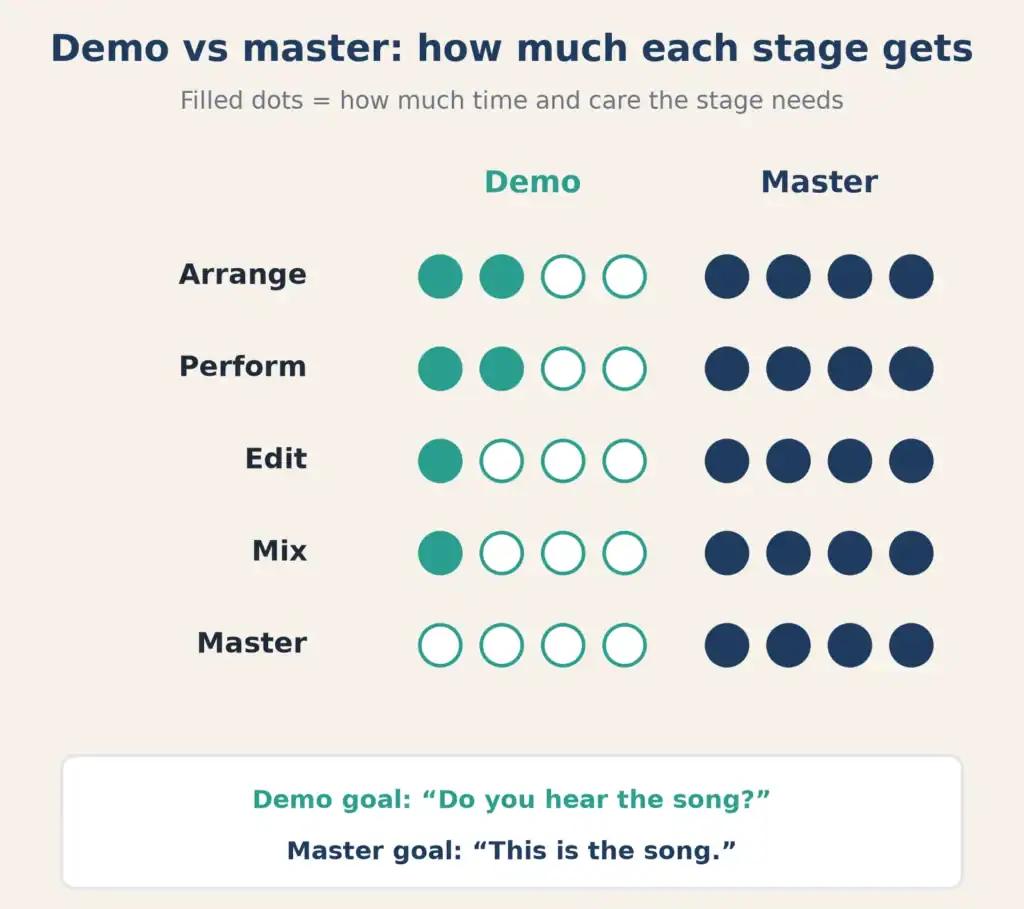
- Goal. A demo asks “do you hear it?” A master says “this is it.”
- Listener. A demo has a small, informed audience. A master has everyone.
- Arrangement. A demo can leave things open. A master has decided.
- Performance. Demos forgive small flaws if the song comes through. Masters don’t.
- Editing. A demo might keep a whole take. A master might be comped and carefully cleaned up.
- Mixing. A demo can live with a rough mix. A master needs a finished one.
- Mastering. Usually skipped on demos, essential for masters.
How to decide what you’re making
Ask three questions
- Who will hear this? If it’s a co-writer or a singer, you’re making a demo. If it’s going to streaming services, you’re making a master.
- What does it need to prove? A demo has to prove the song works. A master has to stand next to other released music.
- How long can you spend? A demo should be fast. If you’re spending weeks, you’re probably making a master — so make that decision on purpose.
Signs your demo is turning into a master
- You keep re-recording parts that already work.
- You’re adjusting the mix more than you’re listening to the song.
- People who hear it don’t ask “who’s going to record this?” — they ask “when’s it out?”
If that’s happening, stop and choose. Either finish it as a demo and move on, or commit to making it a master and plan the work properly.
Taking a demo to master quality at home
Many home recordists start with a demo and grow it into a master. That can work well if you’re deliberate:
- Re-record the parts that carry the song, especially the lead vocal and main instrument. Start with a fresh scratch vocal if the arrangement has changed.
- Edit carefully. Clean up timing, choose the best takes, and remove noises.
- Mix properly. Songsmith’s 8 steps to mix music is a good place to start.
- Decide on mastering. Whether you master it yourself or have it done, the master stage is what makes the recording release-ready.
For the bigger picture of how a song moves from idea to finished record, see what are the steps to producing a song.
FAQ
What is the difference between a demo and a master?
A demo shows what a song is and could become; a master is the finished recording that gets released. A demo is usually quicker and less polished; a master is fully performed, mixed and mastered.
What does song demo mean?
A song demo is a demonstration recording of a song, made so others can hear it — for example, co-writers, singers, producers or collaborators.
How polished should a songwriter demo be?
Polished enough that the melody, lyrics and feel are unmistakable. Beyond that, extra polish rarely helps a demo do its job.
Is a work tape a demo?
Not quite. A work tape documents a finished song as plainly as possible. A demo presents it, usually with more arrangement and care.
Do demos get mixed and mastered?
Demos are usually given a quick, rough mix, and they’re rarely mastered. Masters are always fully mixed and mastered.