
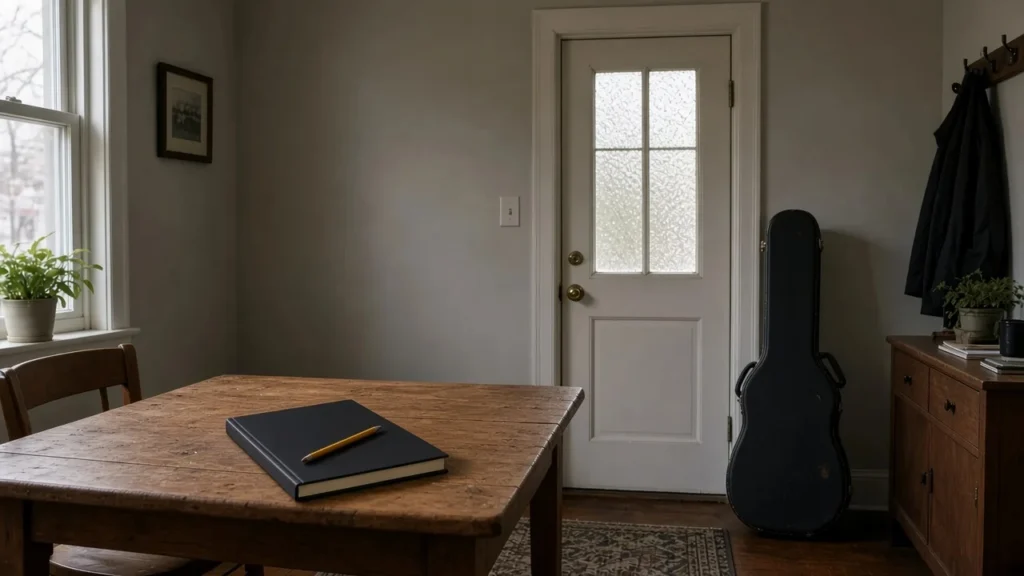
Home recording is making the record, or a serious draft of it, in a space you control. A professional studio is a dedicated room, with an engineer and a listening environment built for the job, that you visit for a purpose. Neither one is automatically “better.” The better choice is the one that serves this song, at this stage, given the room you have and the recording you actually need.
This page is a decision guide, not a budget sheet. It will not tell you what a session should cost, or whether a studio is a good investment in financial terms. It will help you decide when the house is enough, when leaving the house will help, and how to walk into either situation with a clear job.
What is a professional recording studio, in practice?
A professional studio is a room — or a set of rooms — designed so you can hear accurately, record quietly, and work with someone whose job is the session. That usually means a treated tracking space, a control room that tells the truth about the low end and the middle, an engineer who can run the session, and a culture of starting on time and capturing takes.
It is not magic, and it is not only a collection of impressive equipment. The useful things you are borrowing are isolation, honest listening, speed, and attention. Isolation so a vocal or an acoustic guitar is not full of dishwashers and street noise. Honest listening so a mix decision is not being made in a corner of a bedroom. Speed so you are not also being the engineer while you try to sing. Attention so someone else is watching levels, notes, and the clock while you perform.
Studios also differ a lot. A small project studio with a careful engineer can be the right professional visit. A large room can be the wrong one if you only need a quiet vocal and a calm mix check. “Professional” here means purpose-built work, not a particular kind of lobby.
A home setup is the opposite kind of resource: it is yours, it is close, and it is available at odd hours. It may be a spare room you have thought about, or a corner that is still fighting you. If you are still setting that room up, start with the space itself — Home Studio Setup for Beginners (Start With the Room) stays on layout and the room, which is the right first problem.
Is it better to record at home or in a studio?
It is better to record at home when the song needs time, when the performances are simple enough for your room, and when you can work without the room becoming the loudest thing on the track. It is better to go to a studio when you need isolation, a more honest room, an engineer, or a kind of recording your house cannot reasonably give you.
Home is often enough, or more than enough, for:
- writing, work tapes, and early arrangement decisions,
- songs that are mostly voice and one or two quiet instruments,
- editing, comping, and a lot of the detailed work that benefits from being able to stop and come back tomorrow,
- parts you can overdub carefully, one at a time, in a quiet hour,
- a demo that only has to show the song clearly.
A professional studio is often the better tool for:
- vocals that have to be very clean, or that you cannot get without a quieter, drier space than you have,
- live tracking with more than one person, where bleed and headphone mixes matter,
- drums, loud amps, or anything your neighbors and your room will not allow,
- mix decisions you do not trust in your listening position,
- a focused performance day, when being out of the house helps you treat the work as a session rather than a hobby squeezed between chores.
Notice that the question is not “which makes a real record?” People finish real records at home, and they make forgettable records in expensive rooms. Could any person record an album takes the home path seriously. The question is which environment removes the actual obstacle in front of this song.
If your obstacle is the writing, a studio will not fix it. Finish the song first. If your obstacle is a boxy vocal or a room you cannot trust, staying home out of principle will not fix that either.
It also helps to say which recording you are trying to make. A sketch, a demo, and a master are different jobs. Demo vs master recording is the right companion when you are deciding how finished the file actually needs to be. A home demo can be the right final form for a writing sample. A studio master is not automatically required because the song is important to you.
If you are mixing up the composition with the recording, Song vs Track: What’s the Difference in Music? is a short clarification. Get the song right, then choose the room that will serve the track.
When a studio visit actually helps
A studio visit helps when you can name the job of the day in one sentence. “Get a finished lead vocal.” “Track live basics.” “Mix in a room I can trust, or at least check the mix there.” “Record a piano we do not have.” Those are good visits.
A studio visit helps less when the song is still changing, when you have not rehearsed, or when you plan to figure out the arrangement in front of a running clock. The studio will still record what you do. It will not invent a finished song while you think.
Good reasons to go, in plain terms:
The room at home is in the recording. Traffic, a ringing space, a noisy computer, a vocal that always sounds like a hallway — if you have already moved furniture and changed hours, and the room is still in the way, a different room is a logical next step. For vocals specifically, the necessity of a vocal booth in your home recording studio can help you decide whether a home fix is still available.
You need another pair of trained ears in real time. An engineer who can say “that was the take” or “the pitch drooped on the last line” is part of what you are going there for, not an extra.
The performance wants a session atmosphere. Some singers and players do their best work when the day is clearly a recording day. Leaving the house, starting at a set time, and being heard by someone else can produce a take that three evenings at home have not.
You need to hear the record outside your usual chairs. If every mix sounds fine at the desk and wrong everywhere else, a professional listening room is a diagnostic tool. You might still finish the mix at home after you have calibrated your decisions.
You are recording something the house cannot hold. This is the most obvious case, and it should not be argued away by ideology about doing everything yourself.
A visit is not automatically the right end of the project. Many people record vocals or basics in a studio, then come home to edit, add quiet parts, and live with the song. That hybrid is a decision too, and often a sound one.
Prepare for a studio day the way you would prepare for a serious home session, only more so. Know the form, the key, the tempo, and which lines are still placeholders. Sleep. Bring the reference recordings and the notes. If the song is heading toward a mix, getting a song ready to mix will keep you from using studio time to discover missing parts.
Do you need a home studio?
You need a place you can work. That may be a dedicated room, or it may be a modest, repeatable corner. You do not need a professional-looking home studio in order to write, to practice recording, or to finish a lot of songs.
A home studio, in the useful sense, is a setup you can return to: a reliable listening spot, a quiet enough hour, a way to capture a vocal or an instrument without rebuilding the house each time. If you have that, you have enough of a home studio to make real progress.
You may want more of a home studio if you record often, if going out for every file would interrupt the work, or if your process depends on late sessions and small revisions. You may not need one if you write acoustically, visit a studio when it is time to record, and are at peace with that rhythm.
“Need” also depends on the kind of music and the kind of life. A quiet singer-songwriter and a person tracking loud drums are not facing the same house. Be honest about the room and the neighbors, not about an ideal version of your career.
Do not postpone writing until the home room is impressive. The songs come first. The room is there to serve them.
How to decide for this song
Use a short, slightly blunt checklist. Write the answers down for the song in front of you, not for “my music” in general.
- What is the job of this recording? Sketch, demo, vocal final, live basics, mix, or something you want to release as the record. Different jobs tolerate different rooms.
- What is actually weak in the home versions you already have? Writing, performance, noise, room sound, or your inability to judge what you are hearing? Only the last three are strong arguments for leaving the house.
- Can the room be improved enough this week? A closet vocal, a quieter hour, a better chair position. If yes, try that first on one song before you make a bigger plan.
- What must be captured in one focused session? If the answer is “a live band” or “a vocal I keep failing to get at home,” a studio day has a clear purpose. If the answer is “I might think of a harmony,” stay home.
- What will you do after the session? If you have no plan for editing, overdubs, or mixing, the file can stall in any room. Decide the next step now.
- How will you know the day worked? One finished lead vocal, or a set of basics you can work on at home, is a good definition. “Make it sound professional” is not.
If the answers point at home, work at home as if it were a session: phone out of reach, a start time, a complete pass. If they point at a studio, go with a job, not with a hope that the room will supply the song.
You can change the decision for the next song. This is not a lifelong affiliation with one way of recording. It is a choice about the file you need this month.
A hybrid that many songs actually want
A lot of good records are not “all home” or “all studio.” They are written and sketched at home, partly recorded at home, and finished — or checked, or partly captured — in a room that is better at one stubborn job.
That hybrid works when you are organized. Keep notes about tempo, key, and which takes are real. Do not record a home vocal you love and then accidentally replace it because a studio day was on the calendar. Do not go to a studio and leave the only copy of the parts on a drive you cannot open the next morning.
Treat both places as tools. The vanity question — “does this count if I recorded it at home?” — is a distraction. The useful question is whether the recording serves the song, and whether you can still hear the song in it.
FAQ
Is it better to record at home or in a professional studio?
It depends on the song and the stage. Home is often better for writing, demos, quiet overdubs, and work that needs time. A studio is often better for isolation, live tracking, a trusted listening room, or a focused performance day. Neither is automatically more “real.”
What is a professional recording studio?
A dedicated space, usually with an engineer, built so you can record quietly and hear accurately. You are borrowing isolation, honest listening, and session attention, not just a different looking room.
When should I go to a professional studio?
When you can name the job of the day, the house is in the way or cannot hold the recording, or you need another trained ear and a session atmosphere. Do not go to discover the song if you can finish that part at home first.
Do I need a home studio?
You need a repeatable place to work. That can be a modest corner. A more complete home room is useful if you record often, but you should not wait for an impressive setup to start writing or to capture simple parts.
Can I do both on the same song?
Yes. Many songs are sketched and partly recorded at home, then taken to a studio for a vocal, basics, or a mix check. Decide what each place is for so you do not redo finished work without a reason.
Will a studio make the song better?
It can make the recording better, and it can help the performance. It will not fix an unfinished song. Take a studio a clear job, and keep the writing standard just as high at home.