
A scratch vocal is a quick, temporary vocal recorded early in a session — usually alongside the first instrument tracks — to guide every part that gets recorded afterward. It’s not meant to be the final lead vocal. It’s there so that you, and anyone else playing on the song, always know where the melody and lyrics are.
If you record your own songs at home, the scratch vocal is one of the simplest habits that makes everything after it easier. Without one, you’re building the house without a floor plan.
What a scratch vocal is
In a traditional studio session, the band tracks the instruments while a singer sings along in a booth so the players can follow the song. That vocal gets “scratched” — thrown away — and replaced later with a carefully performed lead. The name stuck.
For a self-recording songwriter, the idea is the same: you record a rough lead vocal first, then use it as a map while you add drums, bass, keys, guitars and harmonies.
Scratch vocal vs guide vocal vs final lead
- Scratch vocal: the first rough take, recorded fast, expected to be replaced.
- Guide vocal: often used to mean the same thing. Some people use “guide vocal” for a reference sung by someone other than the final artist — for instance, a writer singing a song meant for another singer.
- Final lead: the performance you keep, recorded once the arrangement is in place.
Why self-recording songwriters need one
You might think you know the song well enough to skip it. You probably do. The problem is that once you’re layering parts, it’s easy to lose track of the phrasing, and every overdub drifts a little away from the song.
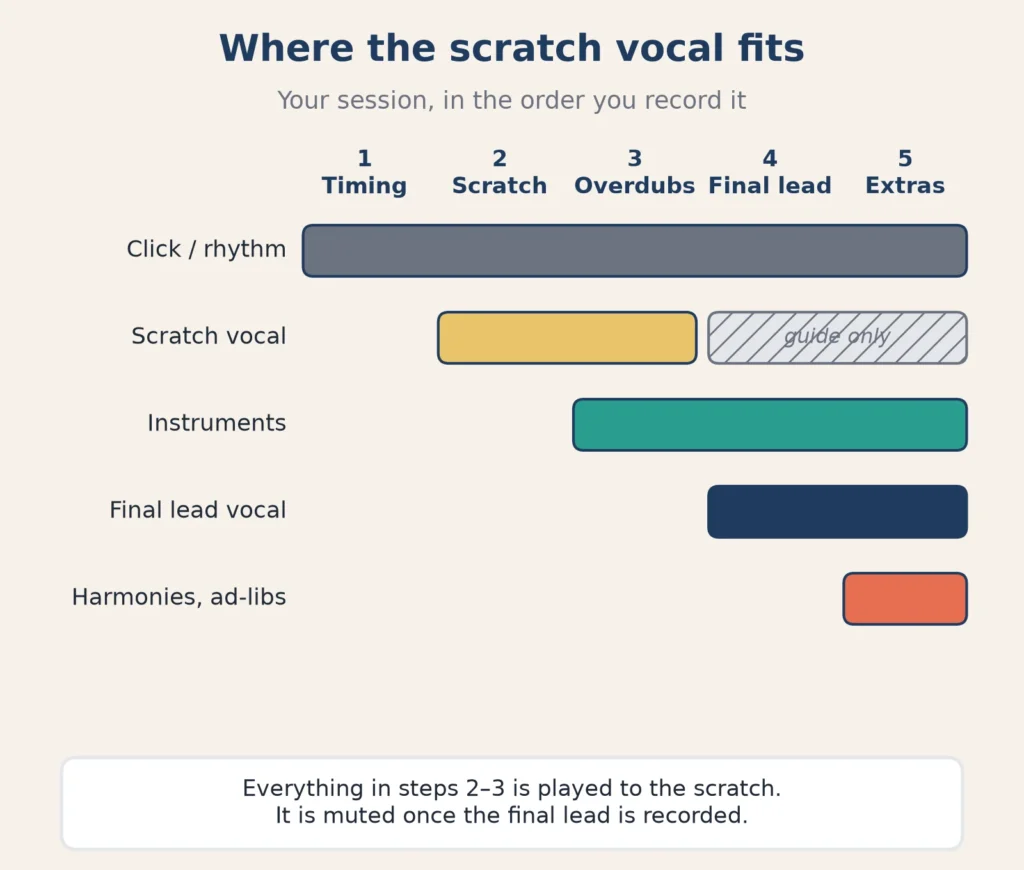
A scratch vocal helps you:
- Play to the melody, not just to the chords. Fills and riffs stay out of the singer’s way.
- Follow the form. You always know whether you’re in verse two or the bridge.
- Hear problems early. A line that’s awkward to sing, or a key that’s too high, shows up long before you’ve built a whole arrangement around it.
- Shape the dynamics. Instruments rise and fall with the vocal’s energy.
How to record a useful scratch vocal
1. Record it first (or nearly first)
The scratch vocal goes down right after your timing reference — either a click track or your main rhythm instrument. Many home recordists record a simple guitar or piano part and the scratch vocal in the same pass, or one straight after the other.
Tip: If you made a songwriting work tape, keep it open. It’s the reference for exactly how the melody and lyrics go.
2. Sing the real melody and the real lyrics
It’s tempting to mumble through, but a scratch with placeholder words or a vague melody doesn’t do its job. Sing it properly enough that every syllable is clear.
3. Mark the sections
Add markers in your recording software for each section, or call them out quietly in a gap — “verse two,” “into the bridge.” When you’re overdubbing later, you’ll know exactly where you are.
4. Don’t polish it
One or two passes, then move on. Don’t comp it, don’t tune it, don’t spend an hour on the mic position. The value of a scratch is that it’s fast.
5. Keep it on its own track and label it
Name the track “SCRATCH VOX” so it’s never mistaken for a keeper, and keep it separate from anything you’ll print later.
Bleed, monitoring and room issues while scratching
If you’re singing and playing an instrument at the same time, some of each will leak into the other’s microphone. For a scratch, that’s usually fine — you’re not keeping it. What matters is that you can hear yourself:
- Keep headphones at a comfortable level so you don’t oversing.
- Turn your own voice up in the headphones a little more than feels natural; it helps pitch.
- If the room is noisy, it doesn’t matter much. Save the room treatment for the final take.
Songsmith’s guide to headphones for the recording artist covers what to listen for when you’re monitoring yourself.
When a scratch vocal becomes the keeper
It happens more often than you’d think. Because a scratch is sung loosely, without pressure, it sometimes has a feel that’s hard to beat. If you hear that in yours:
- Judge the performance before the technical flaws. Emotion is harder to recreate than a clean signal.
- Listen for problems that can’t be fixed later, such as heavy distortion, a loud background noise or the guitar drowning out the voice.
- If the feel is great but parts are rough, consider keeping the strongest lines and re-recording the rest using punch-in recording.
If you think there’s a chance you’ll keep it, record the scratch with a bit more care: a decent mic position, a quiet room, and a sensible level.
Replacing the scratch: tracking the final lead
Once the arrangement is built, mute the scratch and record your final lead. The instruments now support the vocal you’ll actually keep, and you’ll often sing better because the song finally sounds like itself around you.
For the final take itself, Songsmith’s 13 tips for recording better vocals at home is a good companion. Once the lead is done, many songwriters add harmonies sung by themselves and ad-libs on top.
FAQ
What does scratch vocal mean?
It means a rough, temporary vocal recorded early to guide the rest of the recording. It’s usually replaced by a final lead vocal later.
Should beginners record a scratch vocal?
Yes. It’s one of the easiest ways to keep overdubs in time and in tune with the song, and it reveals problems with the key or lyrics early.
What’s the difference between a scratch track and a demo?
A scratch track is a temporary part inside a recording session. A demo is a complete recording of a song, made to present it. See demo vs master recording for more.
Can you keep a scratch vocal on the final song?
You can, if the performance is strong and the recording is clean enough. Plenty of artists have kept a scratch because the feel was right.
What is a scratch vocalist?
A scratch vocalist is a singer brought in to sing the scratch or guide vocal during a session, often when the final artist isn’t available.