
A songwriting work tape is a simple, unpolished recording of a finished song — usually just one voice and one instrument — made right after writing so the melody, lyrics, chords, form and tempo are locked down exactly as written. It isn’t meant to impress anyone. Its only job is to remember the song for you, and to show co-writers, singers or a producer what the song actually is.
If you’ve ever come back to a song a week later and couldn’t remember how the second verse went, or which chord the pre-chorus landed on, you already know why work tapes matter. Songs drift. A work tape freezes the version you meant.
What a work tape is (and isn’t)
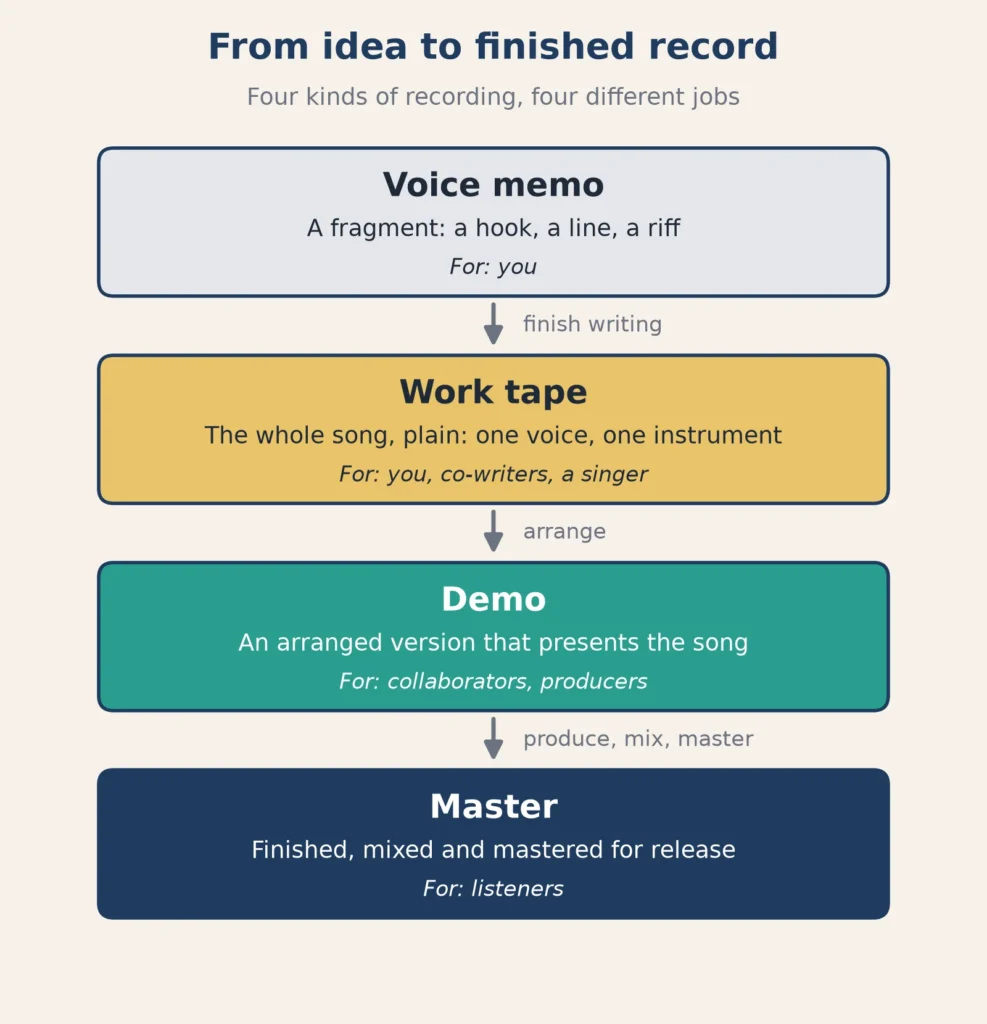
A work tape sits between the scraps you capture while writing and the demo you might make later. It’s easy to blur those together, so here’s the difference:
| Idea capture (voice memo) | Work tape | Demo | |
|---|---|---|---|
| When | While writing | Right after the song is finished | After the song is settled |
| What’s on it | A hook, a line, a melody fragment | The whole song, top to bottom | An arranged, produced version |
| Polish | None | Clear but plain | Enough to sell the song’s feel |
| Audience | You | You, co-writers, a singer, a producer | Listeners, collaborators, pitches |
If you want the full picture of how a work tape becomes a demo and eventually a finished record, see demo vs master recording.
Who a work tape is for
- Future you. The most important listener. You will forget details.
- Your co-writers. Everyone leaves the session with the same version.
- A singer or player. They learn the song from it before a session.
- A producer. They hear the song itself, without anyone’s production ideas on top.
What a work tape must capture
Think of the work tape as a document. In rough order of importance, it needs:
- The melody, sung exactly as written — not a riff on it.
- The lyrics, every word, including every chorus even if it repeats.
- The chords and feel of the accompaniment.
- The form — the order of sections, how many times the chorus comes back, whether there’s a bridge or a tag.
- The tempo, roughly. Close enough that nobody plays it twice as fast.
Say the song info out loud first
Before you play, speak a short slate into the recording: the song title, the date, the key, a rough tempo, and who wrote it. It takes ten seconds and saves a lot of guessing later. When the file name gets mangled or a co-writer renames it, the information is still inside the audio.
How to record a work tape in one sitting
You don’t need a studio for this. The steps below assume a phone or any simple recorder and a quiet room.
1. Pick the quietest room you have
Soft furnishings help — a bedroom usually beats a kitchen. Turn off fans and anything that hums. You’re not chasing a great sound, just a clear one.
2. Place the recorder sensibly
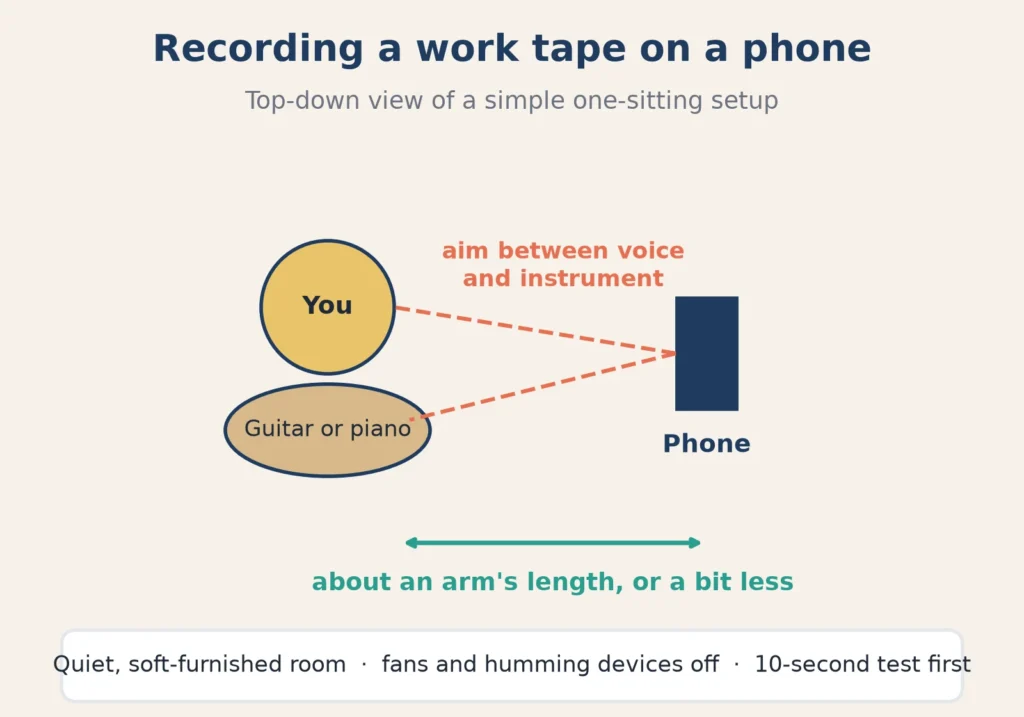
Set the phone or recorder roughly an arm’s length or a bit less from you, pointed between your mouth and your instrument. Too close and the guitar or piano swallows the vocal; too far and the room swallows both. Do a ten-second test and listen back before you commit.
3. Keep the accompaniment simple
Guitar/vocal or piano/vocal is the standard. Strum or play the chords plainly so the melody is easy to hear. This isn’t the moment for your fanciest picking pattern — if the part matters to the song’s identity (a signature riff, say), play it clearly once and keep the rest simple.
4. Hold a steady tempo
Tap your foot, or practise with a metronome a couple of times first and then play without it. You don’t need a click on the work tape itself, but you do want the tempo close to how the song should feel.
5. Play the whole song top to bottom
No stopping to fix a fumbled line. If you make a mistake, keep going — a work tape with a stumble is far more useful than three half-takes. If it’s a mess, start again from the top.
6. Optional: add a second pass
If the instrumental part is tricky or important, record a second pass of the accompaniment alone, or a slow version of the riff. Singers sometimes appreciate an a cappella pass of the melody too, especially when the chords might pull them off pitch.
Label, store and share it
A great work tape that nobody can find is useless.
- Name it consistently, for example:
Song Title – Work Tape – 2026-10-28. Put the date in a sortable format. - Keep it in one place with the lyrics. A clean, typed lyric sheet with every chorus written out is the work tape’s natural partner.
- Back it up. Keep a copy somewhere other than the phone you recorded it on.
- Share the same file with every co-writer, so nobody works from an older version.
After the work tape: what comes next
Once the work tape exists, the song is safe, and you can start making choices. Many writers turn the work tape into a home demo; some go straight into proper pre-production. If you’re planning a fuller recording, Songsmith’s guide to pre-production walks through how to prepare. When you start tracking, a scratch vocal is usually the first thing you record — and your work tape is the reference you’ll sing it against.
If you’re still at the stage before a song is finished, see how to turn a voice memo into a song, and Songsmith’s 11 steps to writing a song.
FAQ
What is a work tape in songwriting?
A work tape is a plain recording of a finished song, usually one voice and one instrument, made to document the melody, lyrics, chords, form and tempo so the song can be remembered and shared accurately.
Is a work tape the same as a demo?
No. A work tape documents the song; a demo presents it. A demo is usually arranged and produced to show how the song could sound on a record. A work tape is deliberately plain.
Can I record a work tape on my phone?
Yes. Most work tapes are recorded on phones. Choose a quiet room, place the phone at a sensible distance, and do a short test recording first.
Should a work tape be recorded to a click?
It doesn’t need to be. A steady tempo matters more than perfect time. Practise with a metronome first if your tempo tends to wander, then record without it.
How long should a work tape be?
As long as the song. Record every section in order, including repeated choruses, so nobody has to guess the form.
What’s the difference between a work tape and a voice memo idea?
A voice memo idea is a fragment captured while writing. A work tape is the complete song captured once writing is done.