
To turn a voice memo into a song, first identify the strongest idea in the recording, then find its key and chords, build a song section around it (usually the chorus), write the remaining sections and lyrics, and record a simple work tape of the finished song. You don’t need special software — just your instrument, a notebook and a bit of patience.
Most songwriters have a phone full of hummed melodies, half-lines and riffs. The ideas are there. What’s usually missing is a method for getting from a 20-second scrap to a finished song. This guide walks you through one, entirely by ear and by hand.
Why voice memos stall (and how to get them moving)
Voice memos are perfect for catching ideas, but they tend to pile up because:
- there are too many to choose from;
- they’re out of context — you can’t remember what you were going for;
- they’re fragments — a hook with no verse, a verse with no chorus;
- starting is harder than capturing.
The fix is to treat each memo as raw material and run it through the same steps every time.
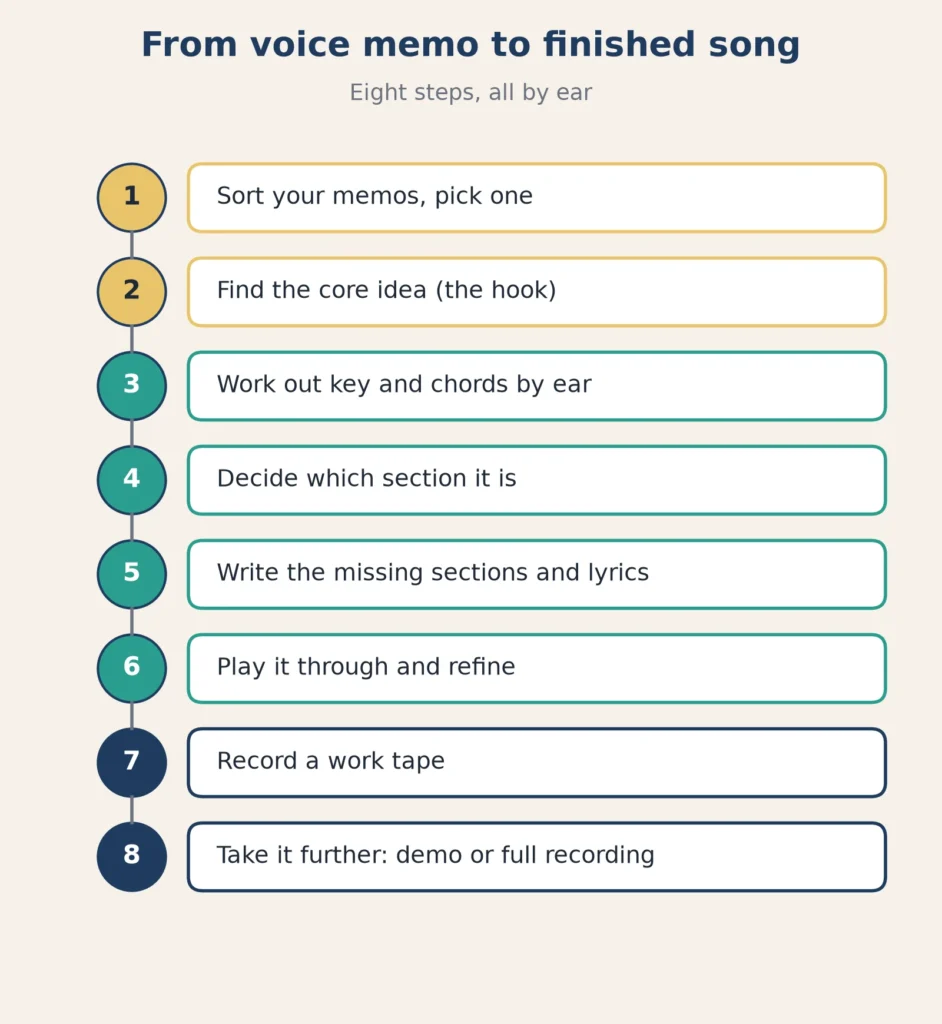
Step 1: Sort your memos
Before you develop anything, take stock.
- Listen through your recent memos in one sitting.
- Rename the good ones with a short description: “fast chorus hook — minor,” “verse melody, sad.”
- Mark your top three. The ideas you still hum later are usually the strongest.
Pick one to work on today. Leave the others for later.
Step 2: Find the core idea
Listen to your chosen memo several times. Ask:
- What’s the hook? The part you’d want to hear again.
- Is it a melody, a lyric, a rhythm, or a chord progression?
- What does it feel like? Happy, restless, tender, angry?
Write down a one-line description of what the song might be about, even if it’s vague. It gives you something to steer by.
Step 3: Work out the key and chords by ear
If the memo is just a sung melody, you’ll need to find chords for it.
- Find the first note. Hum along with the memo and match it on your instrument.
- Find the home note. Usually the note the melody keeps returning to or ends on. That’s likely your key.
- Try the basic chords in that key. Play along and listen for which chords fit under each part of the melody.
- Write it down. Even rough notes like “starts on G, goes to C under ‘tonight'” are enough.
If your memo was sung too high or too low, change the key now — before you build anything on it.
Step 4: Decide what section the memo is
Most memo ideas fit naturally as one section:
- a catchy, repeating idea usually wants to be a chorus;
- a conversational, story-telling idea often wants to be a verse;
- a contrasting, lift-off idea might be a pre-chorus or bridge.
Once you know what it is, you know what’s missing.
Step 5: Build the rest of the song around it
Write the missing sections
If you have a chorus, write a verse that leads to it. Make it contrast: lower in pitch, more words, less repetition. If you have a verse, write a chorus that lifts: higher, simpler, with the title in it.
Write the lyrics
Use the original memo’s words as a starting point, even if they’re nonsense. Sometimes a placeholder word sticks because the sound is right. Fill in the story so each verse adds something new.
Choose a simple form
A classic structure keeps you moving:
Verse – Chorus – Verse – Chorus – Bridge – Chorus
You can change it later. Songsmith’s 11 steps to writing a song covers the writing process in more depth.
Step 6: Play it through and refine
Play the whole song several times in a row. Notice where you stumble or lose interest — that’s where the song needs work. Then:
- tighten lines that feel vague;
- check the melody still sits comfortably in your voice;
- make sure the chorus is the strongest part.
Write out a clean lyric sheet with every section in order.
Step 7: Record a work tape
Now that the song exists, capture it properly. A songwriting work tape — one voice, one instrument, top to bottom — documents the finished song so you don’t lose it again. That’s the real milestone: the memo has become a song.
Step 8: Take it further (if you want)
From here, you might:
- make a demo to hear the song’s potential (see demo vs master recording);
- start recording properly, beginning with a scratch vocal;
- plan a full production with proper pre-production.
If you’re wondering whether you can take songs all the way to finished recordings on your own, Songsmith’s article on whether any person could record an album is worth a read.
Habits that make better voice memos
- Say what it is at the start: “chorus idea, slow.”
- Record more than you think — sing it two or three ways.
- Include a bit of context, such as a strummed chord, if you have an instrument nearby.
- Review your memos weekly, so ideas don’t get buried.
FAQ
How do I turn a voice memo into a song?
Identify the strongest idea, find its key and chords, decide which section it is, write the other sections and lyrics around it, then record a work tape of the finished song.
What if I can’t play an instrument?
You can still develop the melody and lyrics, and record a sung work tape. Working with a musician friend to find the chords is a common and effective approach.
How do I find the chords to a hummed melody?
Find the home note the melody returns to, which is usually the key, then try the basic chords in that key under each phrase until they fit.
Should I keep the original voice memo?
Yes. Keep it with the song’s files. It’s a useful reference for the idea’s original feel.
What’s the difference between a voice memo and a work tape?
A voice memo captures an idea while writing. A work tape documents the complete song once writing is done.