
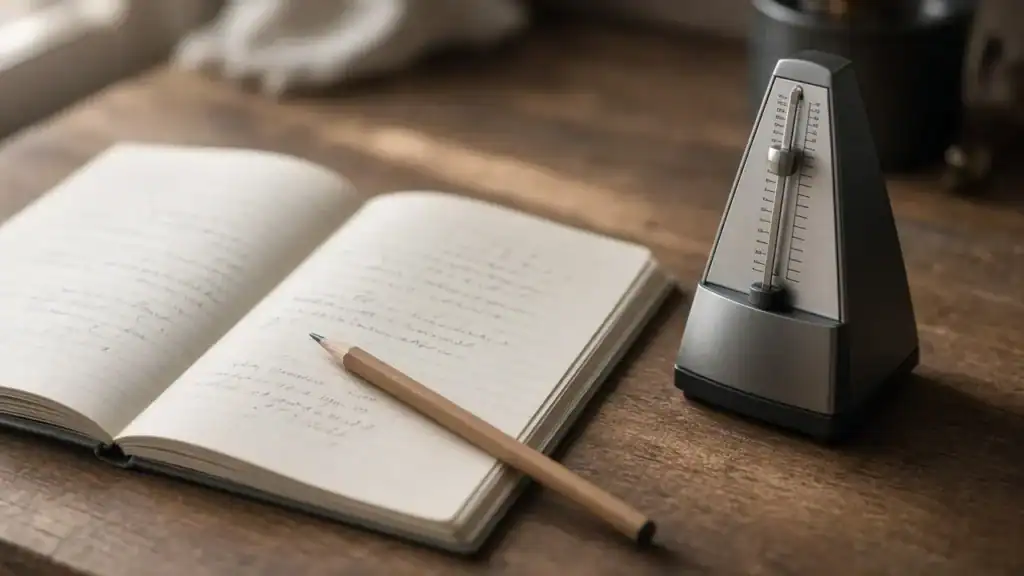
Fitting lyrics to a beat means placing the words in time so they can be sung clearly, with the right stresses, without rushing, mumbling, or padding. The beat is not an enemy of the lyric. It is the grid the lyric has to live on. When the fit is good, you can hear every important word and still feel the pulse.
This is a writing problem as much as a singing problem. You can fix a lot of it on a page and in a spoken pass, before you ever polish a vocal. No special software is required — a metronome, a simple beat, or even a foot tap is enough to hear the truth.
How do you know if a song fits a beat?
You know it fits when you can speak the lyric in time, then sing it, and the important words land in places that feel inevitable. The title should have a clear landing. You should not have to cram three extra syllables into the end of a bar. You should not have to stretch a short line until it sounds padded. And a listener should be able to catch the line on a second listen, not only if they already have the lyric sheet in front of them.
A practical test, in order:
- Count the beat out loud, or let a metronome do it, at the tempo you actually want.
- Talk the lyric in time, at speaking volume, as if you were telling one person the story.
- Mark every place you run out of room, arrive early, or smash two stresses into the same beat.
- Sing the same pass, once, without fixing anything. Record it.
- Listen back without looking at the page. If you cannot tell what you just said, the fit is not done.
“Fits the beat” does not mean every syllable sits on a downbeat. Plenty of good lines lean ahead, sit behind, or fill the space between kicks. The test is whether that leaning is a choice, or a desperate attempt to fit too many words into a bar that cannot hold them.
You also know a fit is close when the natural stress of the words matches the strong beats, most of the time. English wants the important words — the nouns, verbs, and the title — to carry stress. If a weak word like “of” or “the” keeps landing on the downbeat, and the word you care about is jammed into a pickup, the line will feel slightly wrong even if the rhyme is clever.
Fitting vocals to a beat without rushing
Rushing is usually a space problem dressed up as a performance problem. If the line is too long, the singer will hurry to reach the end before the next downbeat. If the singer is anxious, they will hurry even when the line is the right length. Fix the line first, then the take.
Start by leaving air. A chorus, especially, often needs room around the title. If you fill every eighth note with a syllable, the hook has nowhere to land and the vocal has nowhere to breathe. The 8 bar chorus is a useful reminder of how little space a hook sometimes has, and how much of that space should be reserved for the line people are meant to remember.
Try these repairs when a vocal keeps rushing:
- Cut a clause, do not announce it faster. “I was standing on the corner of the old street when I saw you” may need to become “I was on the old street when I saw you,” or two shorter lines in two bars.
- Move a word to the previous bar. A pickup — a syllable or two before the downbeat — can save a title so it can land cleanly on beat one.
- Hold a word instead of adding a new one. If you have leftover space, holding “stay” is usually better than adding “right here with me tonight” just to look finished on the page.
- Speak it slower than you think. If you cannot speak the line in time at a modest volume, you will not sing it in time with feeling. Slow the tempo a little, or cut words. Do not ask the vocal to be the only thing that is rushing.
- Mark breaths. Write a small breath mark on the page where a real person would breathe. If there is no place to breathe, the line is too long or the phrases are in the wrong place.
A scratch vocal is a good honesty check, because it is too unfinished to hide behind performance style. If you use one, scratch vocals explains the job of that rough take: it should tell you whether the words and the beat already belong together.
Stay with one tempo long enough to learn the truth. Changing the beat every two minutes can make a crowded lyric feel briefly comfortable and then fall apart later. Find a tempo where the words can walk, then write to that walk.
What if the lyrics are too long for the beat?
Then the lyrics have to get shorter, or the music has to give them more time. Those are the two honest options. Hoping the singer will “just make it work” usually produces a take that sounds crowded and a lyric no one can remember.
Shorten first, because it is the more common fix and it often improves the writing.
Write the line out and underline the words the song cannot live without — usually the title, one image, and the verb. Everything else is a candidate for the cut. Adjectives, double explanations, and restated feelings are the first to go. “I still remember the night we drove out past the river and I knew it was over” may be two lines, or it may be “We drove past the river / I knew it was over,” depending on the melody.
If a whole verse is too long, you may have written a sixteen-bar idea in an eight-bar space, or an eight-bar idea in a four-bar space. That is a form problem. Either give the verse more bars or say less. The 16 bar verse is worth reading if your story genuinely needs a longer box. Do not try to pour a sixteen-bar story into eight bars by singing twice as fast.
Sometimes the lyric is not too long in total, but it is front-loaded. All the information arrives in the first two bars, and then the last two bars have to be filled with empty extra words. Move one fact later, or let the last bar be a hold.
If the words are already as tight as they can be, and the story still needs them, change the music:
- Slow the tempo slightly.
- Give the line two bars instead of one.
- Drop a wordless bar before the title so the singer can arrive.
- Repeat a short phrase instead of adding a new long one.
Do not add a new beat under the same packed line and call it solved if the vocal is still gasping. The listener hears the vocal first.
A working method you can use on any draft
Here is a method that holds up on almost any draft, because it does not depend on a particular app or a particular kind of beat.
Write the lyric in phrases, not in a paragraph. A phrase is what you can say in one breath. If a “line” on the page is actually two breaths, split it.
Count the bars of the section. Know whether you are writing to eight bars or sixteen, and whether the title lands in bar one, bar three, or at the end. Mystery about the form produces mystery crowding.
Speak a whole section in time, standing up. Sitting and muttering hides the places you will rush. Standing makes the breath honest.
Circle every collision. A collision is two stressed syllables fighting for one strong beat, or a long word piled on a short musical hole. Fix collisions before you worry about rhyme. A slightly less perfect rhyme that sits is better than a perfect rhyme that trips.
Sing only the title and the last word of each line, once. If those land, you have a skeleton. Fill the rest of the words around the landings, not the other way around.
Record a spoken pass and a sung pass. Compare them. Places where the spoken version is clear and the sung version is muddy are almost always fit problems, not “vocal style.”
Change one thing at a time. Cut words, or change rhythm, or change tempo. If you change all three, you will not know what worked.
If you need a timed drill to force this kind of cutting, some of the mid-song exercises in Songwriting Exercises That Get a Stuck Song Moving are built for it, especially speaking a lyric on the beat and cutting a section in half.
When the words already sit and you are asking a different question — whether they are any good — switch pages: How to Know if Your Lyrics Are Good (A Practical Check). A line can fit perfectly and still be vague. Fit first, then quality, or you will polish a sentence that cannot be sung.
What about writing a beat to the song instead?
Sometimes the lyric and melody already work, and the beat should come second. That is a normal order, especially if you write on a guitar or at a piano. In that case, you are not “fitting lyrics to a beat” so much as building a rhythmic bed that respects the lyric you already have.
The same tests apply in reverse. If a later beat makes you rush a line that used to sit, the beat is too busy or too fast, or the snare is in a place that fights the title. Keep the words, and adjust the bed. You do not have to start with a loop every time.
If you do start with a beat, do not treat it as sacred. Move the first line by a beat. Leave a bar open. Change the tempo a few BPM. The lyric has rights in the arrangement too.
Common ways a good lyric still misses the beat
The line looks even on the page, with similar syllable counts, but the stresses fall on different words in verse one and verse two. Verse two then feels awkward in the same melody. When you write later verses, speak them in the rhythm of verse one before you commit to the new words.
The chorus title is buried in the middle of a long sentence. Pull the title out and give it a bar, or the end of a bar, of its own.
The rhyme is dictating the rhythm. You kept a longer word because it rhymed, and now every chorus ending is a scramble. Choose a rhyme that sits, even if it is plainer.
The beat is doing too many accents, and the vocal is trying to acknowledge all of them. The vocal can ride over a busy beat if the line is simple. It cannot comment on every kick.
FAQ
How do you know if a song fits a beat?
Speak the lyric in time, then sing it, and listen without the page. If the important words land cleanly, the title has a place to sit, and you can understand the line, it fits. If you are cramming or padding, it does not yet.
How do I fit vocals to a beat without rushing?
Leave space around the title, cut clauses instead of speeding up, use pickups so key words can land on a downbeat, and mark real breaths. If you cannot speak the line in time, the take will rush.
What if the lyrics are too long for the beat?
Shorten the lyric or give it more musical time. Underline the words the song needs, cut the rest, or add bars or slow the tempo. Do not ask the singer to solve a writing problem by hurrying.
Do all syllables need to land on the beat?
No. Good lines often sit ahead of or behind the beat. The stressed words should still make sense against the strong beats, and any leaning should be a choice, not a squeeze.
Should I write the lyric first or start with a beat?
Either order can work. If the lyric already sings, build the beat around it. If you start with a beat, keep it flexible until the words can be said clearly in time. The finished song has to hold both.