
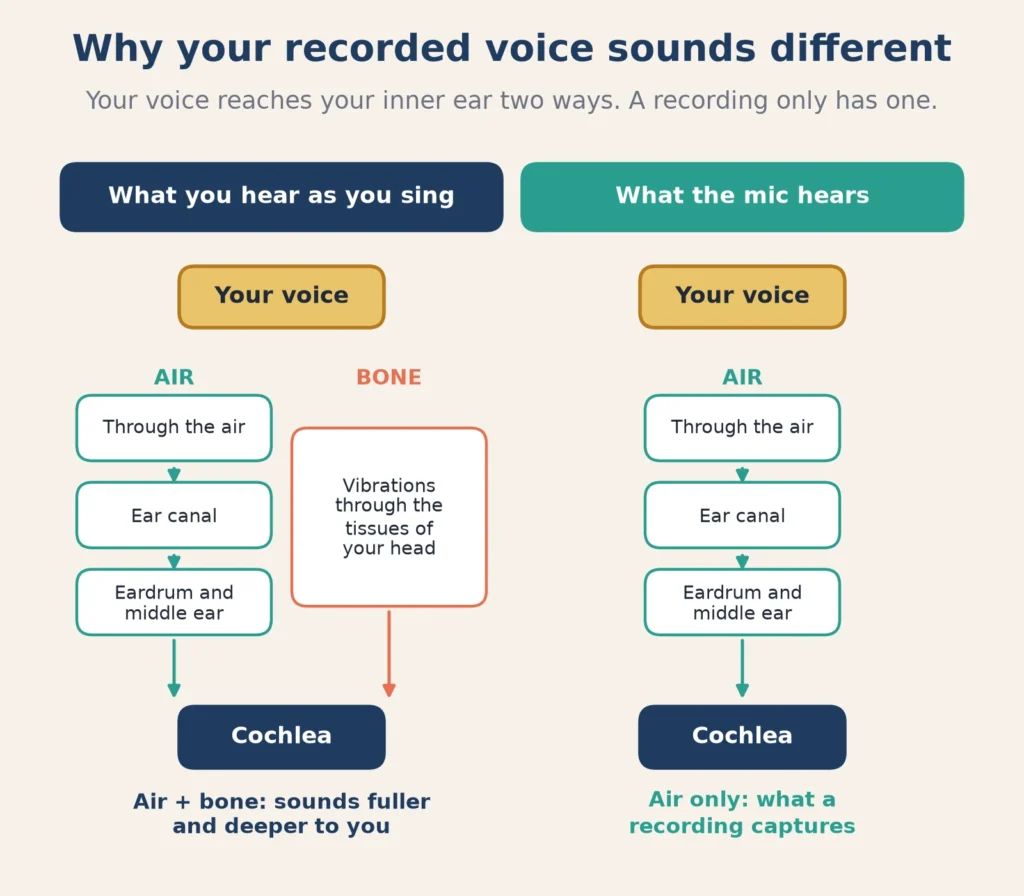
Your voice sounds different when recorded because, when you speak or sing, you hear yourself through two paths: sound traveling through the air to your ears, and vibrations traveling through the bones of your head straight to your inner ear. A recording captures only the air path. The bone path, which adds depth and warmth to the voice you are used to hearing, is missing, so the recording sounds thinner, higher and unfamiliar.
The recorded version is close to what other people hear when you talk. That is often the uncomfortable part. For a singer recording at home, though, the real question is what to do about it. This article covers the science briefly, then how to tell normal “that’s not me” shock from a recording problem worth fixing.
Why does my voice sound different when recorded?
Scientific American explains it in Why does my voice sound so different when it is recorded and played back? Sound reaches your inner ear in two ways:
- Air conduction: sound travels through the air, into your ear canal, past your eardrum and middle ear to the cochlea.
- Bone conduction: vibrations from your vocal cords travel through the tissues of your head directly to the cochlea.
When you hear someone else, nearly everything arrives by air. When you hear yourself, you get both. The article notes that “the mechanical properties of your head enhance its deeper, lower-frequency vibrations,” so the bone-conducted part makes your voice sound fuller and deeper to you.
A recording removes that part. In the article’s words, the bone-conducted pathway “that you consider part of your ‘normal’ voice is eliminated, and you hear only the air-conducted component in unfamiliar isolation.”
The University of Tokyo makes the same point in Why do recordings of one’s own voice sound so strange? Research associate Miki Yonemura explains that the recorded, air-transmitted version of your voice “is the same as what other people hear when you speak.”
You can test this yourself. Put your fingers in your ears and talk. What you hear is mostly the bone-conducted version, boomy and muffled. A recording gives you the opposite: the air version alone.
Why does my voice sound deeper or weirder to me than to other people?
Because the voice in your head includes that extra low-frequency boost from bone conduction. To you, your voice has more bass and body than it does to anyone else. On a recording, you hear it without that boost for the first time, so it seems higher, thinner or nasal.
Part of the discomfort is also familiarity. You have heard your “inside” voice your whole life. The recorded version is a stranger’s voice coming out of your mouth, and that mismatch can feel jarring even when the recording is perfectly accurate.
Why does my singing voice sound different on a recording?
Everything above applies to singing, often more so. When you sing, especially with power, the bone-conducted sound in your head is strong. You may feel resonant and full while singing and then hear something lighter on playback.
There are also performance factors:
- Pitch: small pitch slips are masked in your head and obvious on a recording.
- Timing: you hear exactly where you rushed or dragged.
- Tone: the warmth you feel inside may not reach the mic, especially if you sing quietly or turn away from it.
This is why singers often say their voice sounds beautiful while singing and disappointing on playback. Usually nothing is wrong with the recording. You are hearing an outside view for the first time.
Is something actually wrong with the recording?
Sometimes yes. It helps to separate “this does not sound like me” from “this does not sound good.” Here is a quick test.
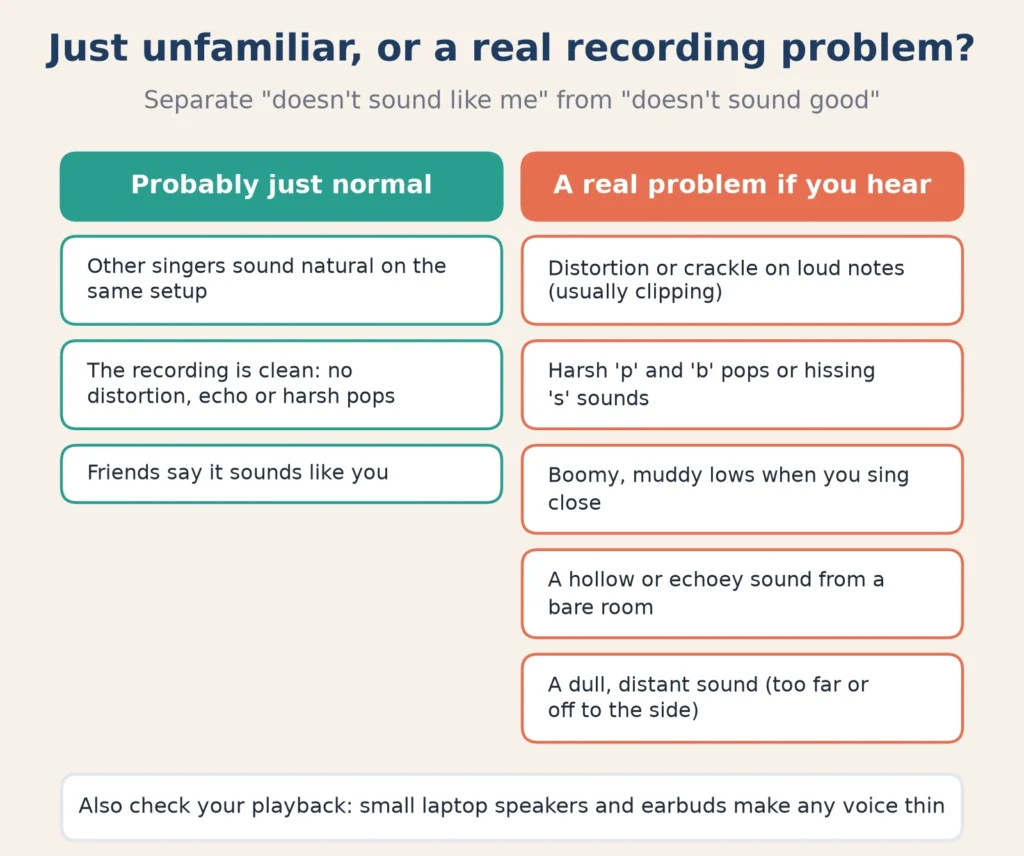
It is probably just the normal difference if:
- Other singers’ voices sound natural on the same setup.
- The recording sounds clean: no distortion, no echo, no harsh pops.
- Friends say it sounds like you.
There may be a real recording problem if you hear:
- Distortion or crackle on loud notes. That is usually clipping.
- Harsh “p” and “b” pops or hissing “s” sounds.
- Boomy, muddy lows when you sing close to the mic.
- A hollow or echoey sound from a bare room.
- A dull, distant sound because you were too far from the mic or off to the side.
If you hear these, they are real faults with known fixes. Our article on 4 major problems with home-recorded vocals covers clipping, plosives, proximity effect and sibilance, and 13 tips for recording better vocals at home covers the setup side.
Also check your playback. Small laptop speakers and earbuds can make any voice sound thin. Listening on accurate speakers helps you judge fairly. Our page on why studio monitors are a necessity explains why.
How do you get used to your recorded voice without chasing a fake “fix”?
You cannot make a recording sound like the voice in your head, because no microphone captures bone conduction. Trying to EQ in that inner warmth usually makes vocals muddy. Here is what actually helps:
- Record and listen often. The strangeness fades with exposure. Singers who record regularly stop noticing it.
- Judge the recording against other recordings, not against your inner voice. Put a favorite vocal in the same genre next to yours and compare tone and clarity, not identity.
- Use headphones while you track. Hearing yourself through the mic while singing helps you adjust to your recorded sound in real time. Our guide to headphones for the recording artist covers this.
- Focus on what you can change: pitch, timing, diction, distance from the mic and emotion.
- Get an outside opinion. Ask someone you trust whether the recording sounds like you. It almost always does.
FAQ
Does my voice really sound like it does when recorded?
Yes, to other people, roughly. A recording on decent equipment is close to how others hear you, because they only hear the air-conducted sound.
How can I hear my real voice?
Record yourself on a good microphone and listen on accurate speakers or headphones. That is the closest you can get to what others hear.
How do I make my voice sound the same when recording?
You cannot add bone conduction to a recording. Focus instead on clean recording technique and good performance, and you will get used to your recorded sound.